When a thermometer reads 96°F and the air is holding 80% relative humidity, your body is coping with something much closer to 137°F. That 41-degree gap is the heat index — and it, not the temperature on the forecast, is what predicts who ends up in an emergency room.
The heat index measures what your body cannot do
Air temperature describes the air. The heat index describes you.
Your body sheds excess heat primarily by evaporating sweat off your skin. Evaporation is a cooling process — it carries energy away with the departing water vapour. But that only works if the surrounding air has room to accept more moisture. When relative humidity climbs, the air is already close to saturated, evaporation slows sharply, and the cooling system you depend on quietly stops keeping up.
The heat index, formalised by physicist Robert Steadman in his 1979 paper The Assessment of Sultriness and adopted by the US National Weather Service, puts a number on that failure. It answers a specific question: at this temperature and this humidity, what dry-air temperature would feel equivalent?
Humidity is a multiplier, not an addition
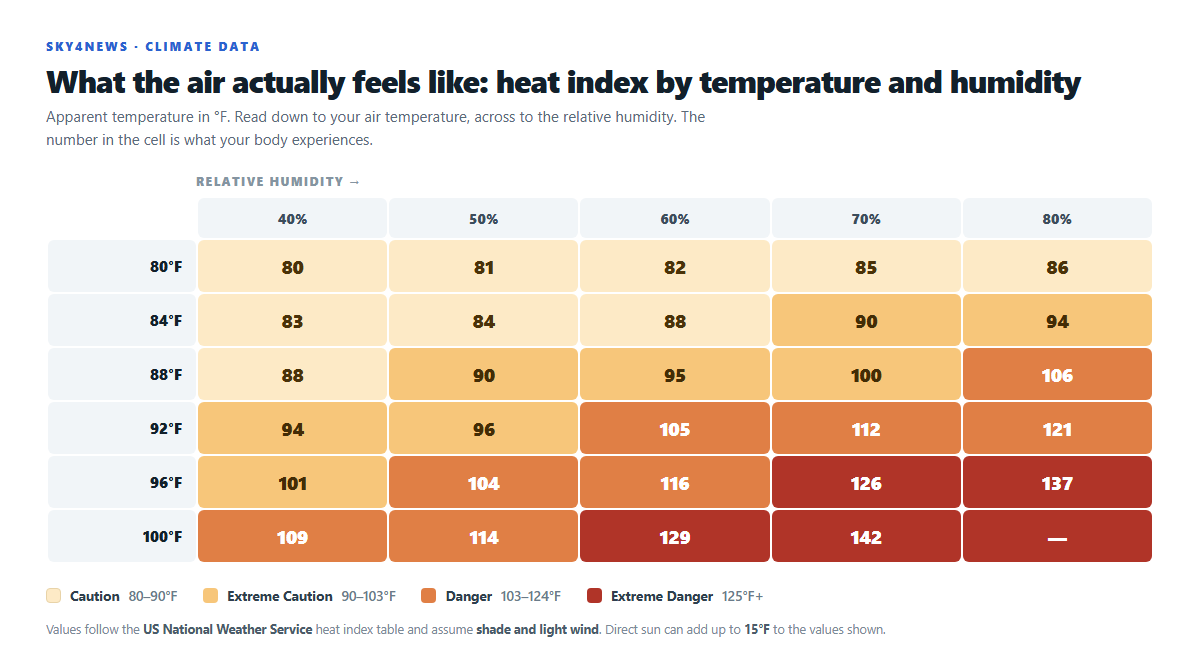
The grid above rewards a second look, because the effect is not linear.
At 80°F, pushing humidity from 40% to 80% moves the heat index by six degrees — noticeable, not dangerous. Run the same experiment at 96°F and the same humidity swing moves it thirty-six degrees, from 101°F to 137°F. Humidity does not add a fixed penalty; it scales with the heat already present.
This is why a humid 92°F afternoon can be more hazardous than a dry 100°F one, and why coastal and river-valley populations face heat emergencies at temperatures that would be unremarkable in Phoenix or Las Vegas.
Every number here assumes you are in the shade
This is the caveat most people miss, and it matters more than any other line in this article.
The NWS heat index table is calculated for shade with light wind. Step into direct sunlight and you can add up to 15°F to every value shown. A reading of 96°F at 70% humidity sits at 126°F in the shade — already Extreme Danger. In full sun, the effective figure lands near 141°F.
So a forecast that looks survivable on paper can describe genuinely lethal conditions for anyone working, exercising, or waiting outdoors without cover.
The thresholds are lower for some people than the chart suggests
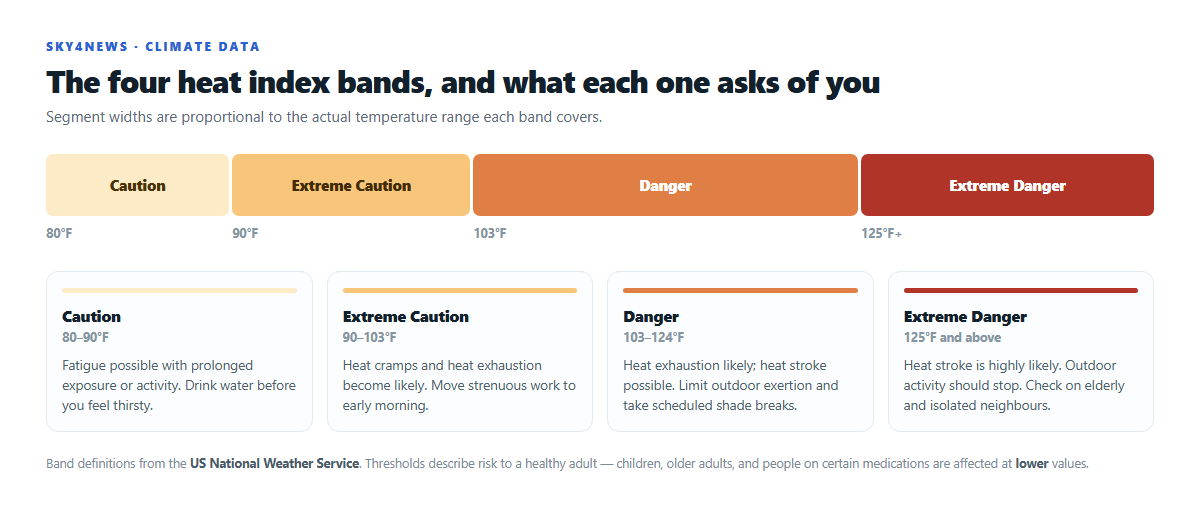
The bands describe risk to a healthy adult. Several groups cross into danger well before the chart says so:
- Adults over 65, whose sweat response and thirst signalling both decline with age
- Children under four, who have a higher surface-area-to-mass ratio and rely on adults to hydrate them
- People on diuretics, beta blockers, antihistamines, or antipsychotics — each can blunt sweating or fluid retention
- Outdoor and warehouse workers, who accumulate heat load across a full shift rather than in a single exposure
- Anyone with cardiovascular or respiratory conditions, for whom the added circulatory strain compounds an existing burden
What actually helps
Hydration is necessary but not sufficient — water alone does not solve a cooling problem caused by saturated air. What reliably works:
- Shift exertion to before 10am or after 6pm. The heat index typically peaks between 2pm and 5pm, lagging behind solar noon.
- Get out of the sun, not just out of the heat. Shade is worth up to 15°F on its own.
- Use moving air only below roughly 95°F. Above that, a fan blows air hotter than your skin across your body and can accelerate heat gain rather than relieve it.
- Watch for the turn. Heat exhaustion presents as heavy sweating, weakness, and nausea. If sweating stops and confusion appears, that is heat stroke — call emergency services immediately and begin active cooling.
- Check on someone. Most heat deaths occur indoors, alone, in homes without functioning air conditioning.
The single habit worth building this summer is simple: when you check the forecast, find the heat index rather than the temperature. It is the number that describes what your body is about to be asked to do.
Heat index values and risk bands in this article follow the US National Weather Service. This is general safety information, not medical advice.